Grid-Down & Extended Outage
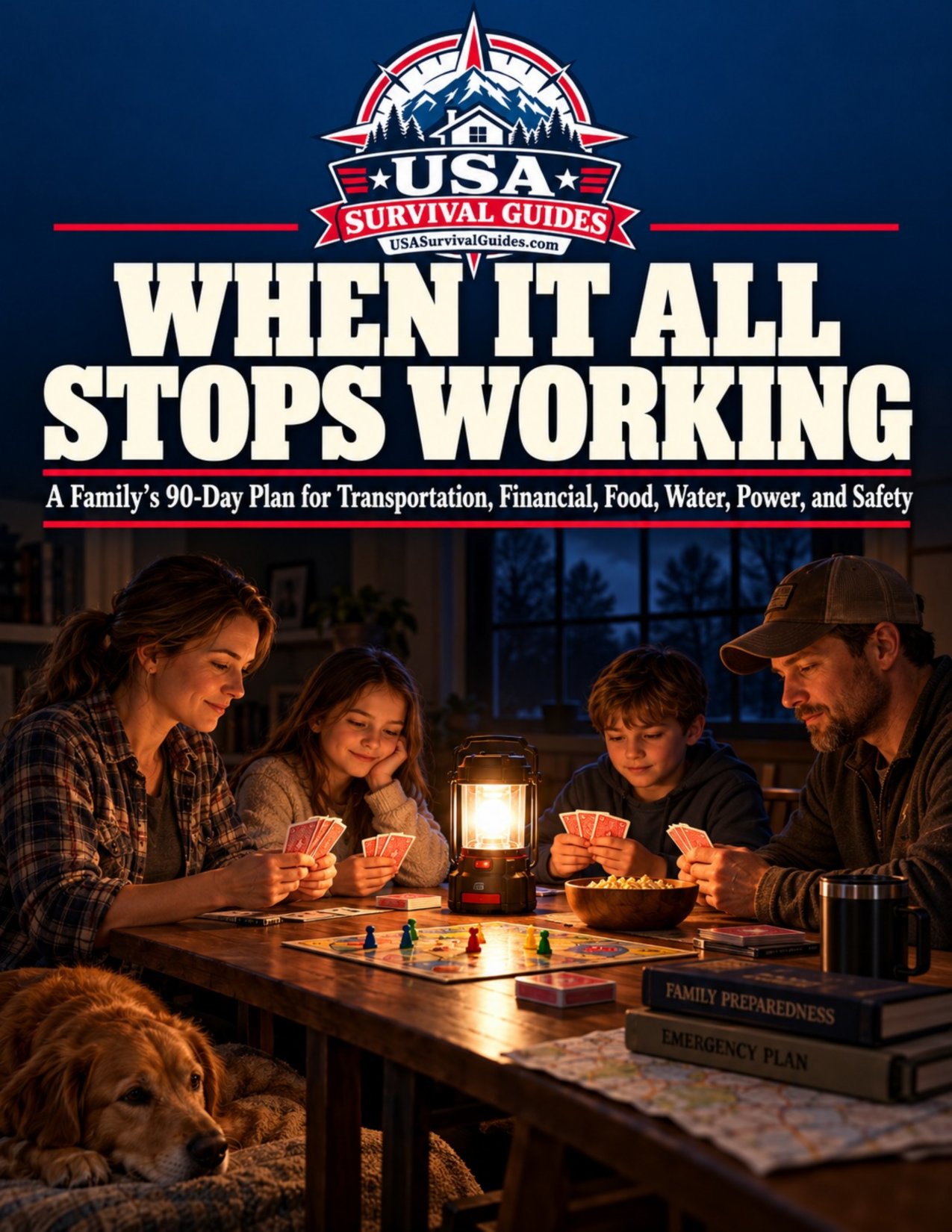
When It All Stops Working
A Family's 90-Day Plan for Transportation, Financial, Food, Water, Power, and Safety
A 90-day household plan for fuel, money, food, water, power, and safety when services fail.
Get this guide
Purchase links coming soon
This guide will be available through third-party retailers in Digital PDF, Digital eBook and Printed Hardcopy formats. Purchase links will appear here as each format becomes available.
Ask us about availabilityFor educational and informational purposes only. Please read the full disclaimer before using this guide.
Look inside
Preview sample pages from this guide
Select any page to read it full size.
About this guide
What you will learn
When one service fails, others can follow. A storm damages power lines, gas pumps stop, card readers go dark, and a short inconvenience becomes a test of how well your household is prepared. When It All Stops Working is a 62-page family guide to planning for that kind of cascading disruption: calmly, practically, and one essential function at a time.
Plan for functions, not a single disaster
Rather than preparing for one imagined catastrophe, the guide helps you list the services your household depends on (drinking water, food, sanitation, medical care, safe temperatures, information, connection, and a safe place to sleep) and record a primary method and an independent backup for each. Chapter 1 explains how disruptions can cascade, using the 2021 Colonial Pipeline incident documented by CISA as an example of why connections matter, without predicting any particular future event. Chapter 2 walks you through a household plan and the decision triggers that tell you when to act.
What's inside
- Transportation and fuel when stations are closed, plus backup fuels and safe cooking
- Backup power and solar generators, including a simple daily power budget
- Water storage, rainwater catchment, and the limits of purification methods
- Sanitation, hygiene, and waste when water service is interrupted
- Food for 30, 60, and 90 days, built in stages
- Medical needs, women's essentials, children, and pets
- Internet, cell networks, radios, and satellite connections
- Banks, ATMs, income, cash, and barter
- Home safety, neighbors, and civil unrest
- Entertainment, routines, and emotional health
- A 90-day household action plan
- Leaving safely, returning home, and improving the plan
Built for real households
Every chapter uses the same easy-to-follow structure. Plan Ahead boxes tell you what to gather or record. Situation Assessment boxes help you decide whether a problem affects you now or is only something to monitor. Practice It prompts turn reading into short family exercises, so the plan becomes something your household has actually rehearsed instead of something that sits on a shelf.
Grounded in official guidance
Health, safety, and planning topics are supported by public sources such as the CDC, FEMA and Ready.gov, the U.S. Fire Administration, EPA, FDA, CPSC, the National Weather Service, the FDIC, the IRS, and the Consumer Financial Protection Bureau. A Sources and Topic Map at the end shows which sources support each chapter, so you can check current guidance yourself. Family routines and illustrative calculations are presented as practical planning examples, not official requirements.
Who it's for
This guide is for families who want more than a weekend kit: households that want a written, realistic plan to stay safe, fed, and connected through a long disruption. Printable planning worksheets at the back help you capture contacts, supplies, triggers, and decisions in one place, ready for the day you need them.
References
Official Sources & Further Reading
Our guides draw on guidance from government agencies and other authoritative organizations. Explore the sources referenced in this guide below.
Government agencies
Centers for Disease Control and Prevention (CDC)
Cybersecurity and Infrastructure Security Agency (CISA)
FEMA / Ready.gov
U.S. Fire Administration
U.S. Environmental Protection Agency (EPA)
U.S. Department of Energy
U.S. Consumer Product Safety Commission (CPSC)
FoodSafety.gov
U.S. Food and Drug Administration (FDA)
Federal Communications Commission (FCC)
Consumer Financial Protection Bureau (CFPB)
Federal Deposit Insurance Corporation (FDIC)
Internal Revenue Service (IRS)
National Weather Service
Nongovernment organizations
National Center for Home Food Preservation
Starlink
Source links are provided for reference. USA Survival Guides is not affiliated with or endorsed by these organizations.