Essential Skills
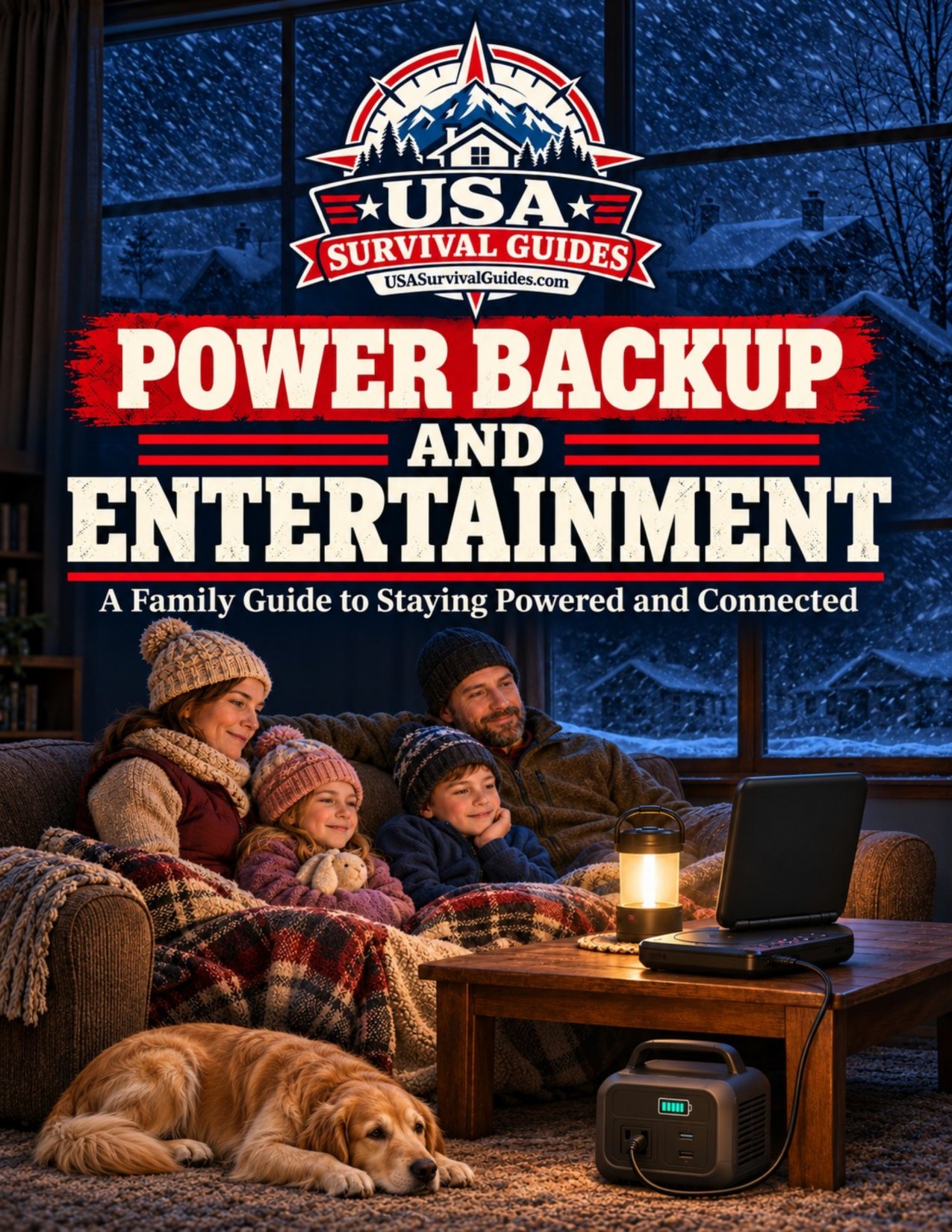
Power Backup and Entertainment
A Family Guide to Staying Powered and Connected
Understand backup power options and keep your family connected and entertained during an outage.
Get this guide
Purchase links coming soon
This guide will be available through third-party retailers in Digital PDF, Digital eBook and Printed Hardcopy formats. Purchase links will appear here as each format becomes available.
Ask us about availabilityFor educational and informational purposes only. Please read the full disclaimer before using this guide.
Look inside
Preview sample pages from this guide
Select any page to read it full size.
About this guide
What you will learn
Backup power decisions are easier when you start with people. Power Backup and Entertainment: A Family Guide to Staying Powered and Connected is a 54-page guide that helps you decide which devices truly need electricity, choose and use backup power safely, and keep spirits up when the screens go dark.
Start with priorities
Chapter 1 ranks needs in a practical order: life and health first (medical devices, mobility equipment, and safe temperature), then water and information, then food protection, and finally comfort and routine. A family walk through the home with flashlights helps everyone find the refrigerator, radio, lights, phones, and medical equipment that matter most.
What's inside
- When the power goes out
- Understanding watts, watt-hours, and runtime
- Batteries every family should understand
- Hearing aids and forgotten batteries
- Portable generators and carbon monoxide
- Battery power stations and solar generators, including estimating solar energy
- Generator versus battery backup
- Dual-fuel generators and shared propane
- Phones, radios, and the internet, with a communication ladder
- Entertainment is part of the plan
- Entertainment without electricity
- A seven-day power routine and printable worksheets
Safety without the jargon
The guide explains power math in plain language so you can estimate how long a battery or generator will run your essentials. It is direct about carbon monoxide: portable generators stay outdoors and away from openings, CO alarms belong near sleeping areas, and solar panels or batteries do not remove the need for a CO alarm when fuel-burning appliances are present. It also covers battery storage and button-battery hazards, cord safety, and why you should never backfeed a home through an outlet.
Fun is part of resilience
Long outages are hard on children and adults alike. Two chapters focus on keeping routines and morale strong, from low-power movie nights to board games, cards, books, and family activities by lantern light, because entertainment is a real part of an emergency plan.
Well sourced
References include the American Red Cross, CPSC, CDC, the U.S. Department of Energy, the National Renewable Energy Laboratory, OSHA, PHMSA, EPA, the FCC, the National Weather Service, FEMA, Penn State Extension, the National Capital Poison Center, NABCEP, and manufacturer documentation for specific products. Product instructions take priority for product-specific operation.
Who it's for
Families comparing generators and battery power stations, households with medical devices or hearing aids, and parents who want a realistic plan to stay powered, informed, and entertained for several days without the grid.
References
Official Sources & Further Reading
Our guides draw on guidance from government agencies and other authoritative organizations. Explore the sources referenced in this guide below.
Government agencies
U.S. Consumer Product Safety Commission (CPSC)
Centers for Disease Control and Prevention (CDC)
U.S. Department of Energy
National Renewable Energy Laboratory (NREL)
Occupational Safety and Health Administration (OSHA)
Pipeline and Hazardous Materials Safety Administration (PHMSA)
U.S. Environmental Protection Agency (EPA)
National Weather Service
Federal Communications Commission (FCC)
FEMA / Ready.gov
Nongovernment organizations
American Red Cross
National Capital Poison Center
Penn State Extension
Energizer
Source links are provided for reference. USA Survival Guides is not affiliated with or endorsed by these organizations.