Essential Skills
Evacuation Planning and Bug Out Bag Preparation
What to Do When It Is No Longer Safe to Stay at Home
Plan where your family will go, how you will get there, and what every person and pet needs to carry.
Get this guide
Purchase links coming soon
This guide will be available through third-party retailers in Digital PDF, Digital eBook and Printed Hardcopy formats. Purchase links will appear here as each format becomes available.
Ask us about availabilityFor educational and informational purposes only. Please read the full disclaimer before using this guide.
Look inside
Preview sample pages from this guide
Select any page to read it full size.
About this guide
What you will learn
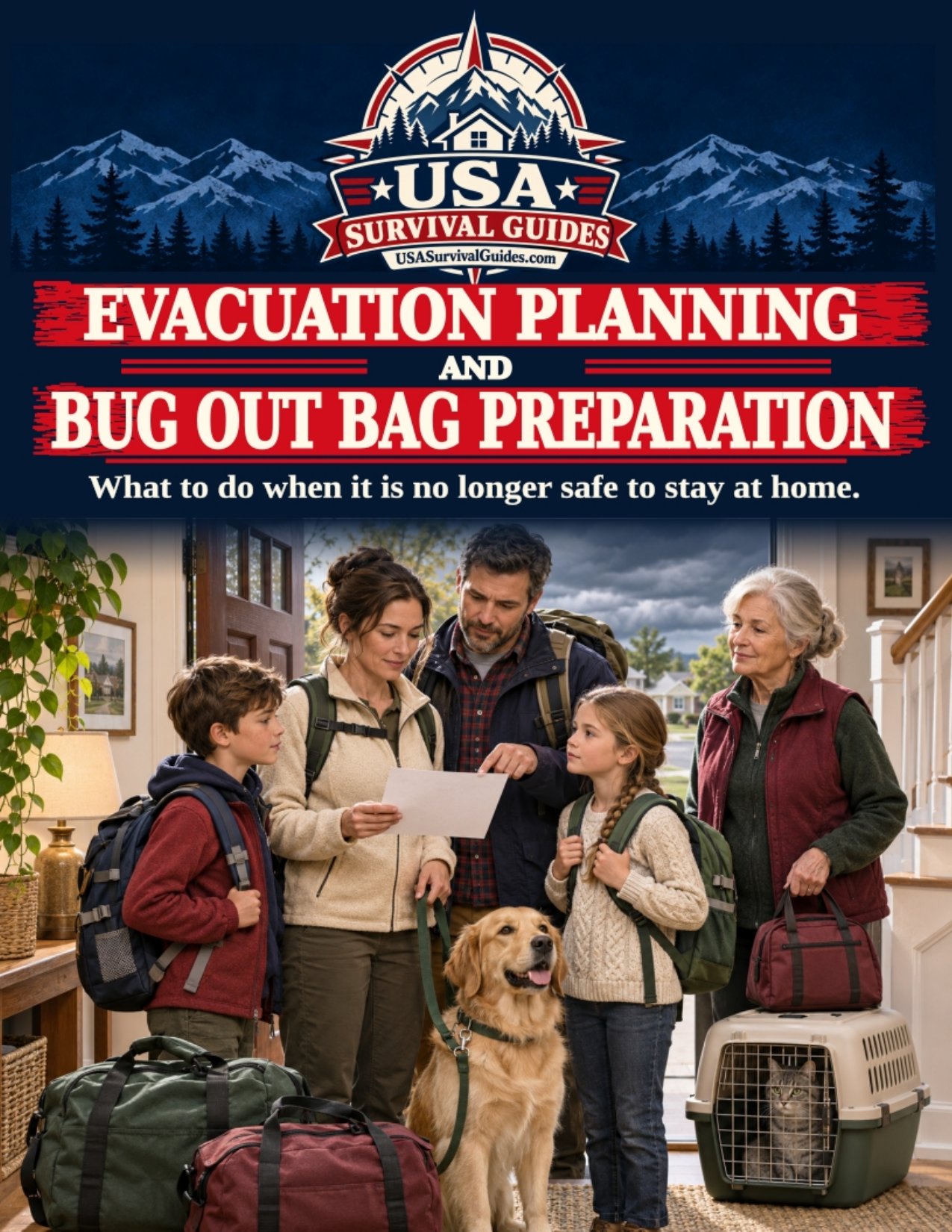
Some emergencies mean staying put. Others mean leaving quickly and safely. Evacuation Planning and Bug Out Bag Preparation is a 93-page family guide to deciding when to leave, where to go, how to get there, and what each person and animal needs for the trip, written in calm, plain language.
Start with four tasks
The guide opens with a simple starting point: save your local alerts, choose two meeting places, three destination options, and a transportation backup, give every person and animal a practical kit and a named helper, and walk through one practice departure. An example family (two parents, two school-age children, an older adult, a dog, and a cat) shows how the plan comes together, so you can fill in your own names, supplies, routes, and helpers.
What's inside
- Know when to leave, from a fire or carbon monoxide alarm to an official evacuation order
- Build the family evacuation plan
- Choose and confirm safe destinations
- Understand emergency shelters
- Plan an out-of-town evacuation
- Arrange transportation and help
- Build a usable bug out bag system
- Pack for every family member, with illustrated packing profiles for Mom, Dad, a son, a daughter, an older adult, the dog, and the cat
- Plan food, water, and hygiene
- Protect infant feeding and essential care
- Leave in the right order
- Travel safely and handle route changes
- Check in and account for everyone
- Stay away longer if you need to
- Return home safely
- Practice and maintain the family plan
A bag system you can actually carry
Instead of one overloaded backpack, the guide spreads supplies across what you keep within reach, each person's own bag, a vehicle or helper, and confirmed supplies at the destination. It shows how heavy water really is (15 gallons for a family of five over three days weighs about 125 pounds) and how to plan for it, including a no-car version.
Printable planning tools
Sixteen household worksheets cover protective actions, family contacts and reunification, comparing destinations, shelter confirmation, transportation and load plans, route cards, food and water allocation, care continuity and backup power, infant feeding, pet care cards, door and arrival cards, extended stays, returning home, and a practice log. Individual packing checklists and cut-out wallet contact cards complete the kit.
Well sourced
The guide cites 57 numbered references, including FEMA and Ready.gov, the CDC, the American Red Cross, the National Weather Service, the U.S. Fire Administration, the FDA, NHTSA, CAL FIRE, the U.S. Department of Justice, and the American Academy of Pediatrics. It always tells you to follow the instructions official sources give for your area.
Who it's for
Families who live where wildfires, hurricanes, floods, chemical incidents, or winter storms could force them to leave, and households caring for young children, older adults, pets, or a family member with medical or mobility needs. It pairs well with our power outage and first-aid guides to complete a household plan for staying or going.
References
Official Sources & Further Reading
Our guides draw on guidance from government agencies and other authoritative organizations. Explore the sources referenced in this guide below.
Government agencies
FEMA / Ready.gov
U.S. Fire Administration
U.S. Consumer Product Safety Commission (CPSC)
Centers for Disease Control and Prevention (CDC)
National Weather Service
CAL FIRE
U.S. Department of Justice
NYC Emergency Management
U.S. Geological Survey (USGS)
U.S. Food and Drug Administration (FDA)
National Highway Traffic Safety Administration (NHTSA)
CDC / NIOSH
Consumer Financial Protection Bureau (CFPB)
FoodSafety.gov
NIH Safe to Sleep
USDA Food Safety and Inspection Service
Nongovernment organizations
American Red Cross
American Veterinary Medical Association (AVMA)
American Academy of Pediatrics (HealthyChildren.org)
South Dakota State University Extension
REI Expert Advice
The Prepared
Prepared States
Source links are provided for reference. USA Survival Guides is not affiliated with or endorsed by these organizations.